
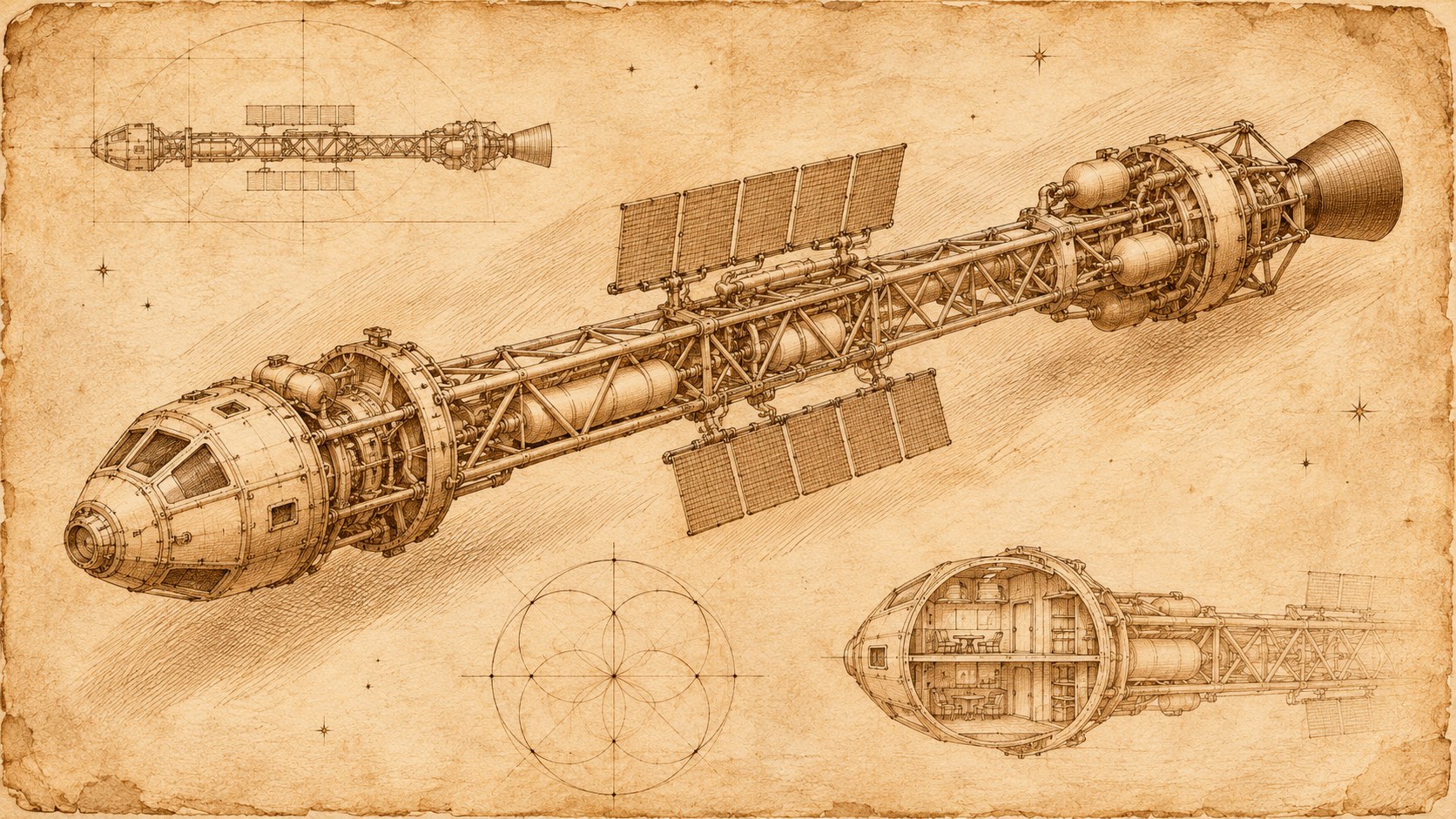
A cup rests on a table. Someone walks across the cabin, sits down and opens a book. Outside, the spacecraft is gathering speed every second. Inside, the passengers feel the same weight they would feel at home.
If a future propulsion system could sustain 1g of acceleration, this familiar scene could accompany extraordinary journeys: roughly three and a half hours to the Moon, a few days across the inner Solar System, and a trip to the nearest star lasting about three and a half years for the people aboard, with braking included.
These are calculated journeys for a hypothetical capability. Their appeal is that they fit within known relativity: the ship never needs to reach the speed of light. The question is what sustained acceleration would make possible.
1. Why 1g would feel familiar
The symbol g represents the acceleration associated with gravity near Earth's surface. For the calculations here, 1g = 9.80665 metres per second squared. At ordinary speeds, maintaining that acceleration adds about 9.8 metres per second to the ship's speed every second. BIPM: standard gravity.
A spacecraft accelerating towards its ceiling would push its floor against the passengers' feet. If that acceleration is 1g, the supporting force would resemble the force they feel while standing on Earth. A released object would meet the advancing floor; inside the cabin, it would appear to fall. This is the local equivalence between acceleration and gravity. Max Planck Institute for Gravitational Physics: the elevator and the rocket.
The practical picture is simple:
- The floor is on the engine side of the inhabited compartment, with the decks perpendicular to the thrust direction.
- People can stand, sit and walk with familiar apparent weight. A cup can rest on a table.
- The feeling depends on acceleration, not on how fast the ship is already moving.
- If thrust stops and the ship coasts freely, that apparent weight disappears. The ship continues moving.
This makes 1g an attractive condition for everyday life aboard. It describes the load felt by the body; quiet machinery, breathable air, adequate space and the rest of a habitable environment would still be part of the ship's design.
What would 1g change for muscles and bones?
Aboard the International Space Station, the body floats and muscles and bones no longer support its usual weight. Muscle mass and strength decline, and weight-bearing bones can lose mineral density. NASA estimates a loss of around 1% per month in these bones without protective measures. NASA: bone and muscle loss in microgravity.
At 1g, ordinary activities would load the body again:
- Standing and walking would engage the muscles that maintain our posture.
- Bones in the legs, hips and spine would once again carry body weight.
- Daily life would include that loading alongside dedicated exercise.
Physically, the ship would remove the absence of gravitational loading, one of the main contributors to these problems. This is an important anticipated benefit of 1g travel. Complete medical protection over a journey lasting years remains to be demonstrated; movement and nutrition would still matter, as they do on Earth.
Research illustrates why duration and delivery matter. In the AGBRESA study, 24 participants spent 60 days in bed. Daily 30-minute exposures to artificial gravity reduced some losses of muscle function but did not preserve aerobic capacity. That brief centrifuge intervention differs considerably from active life aboard a ship providing continuous 1g. Kramer and colleagues, 2021 — AGBRESA study.
2. Give that gentle acceleration enough time
A short push changes speed a little. A steady push maintained for hours changes the scale of the journey.
Starting from rest, one day of 1g acceleration would bring our ideal ship to approximately 847 kilometres per second relative to Earth. The passengers would still feel their usual weight. They would not feel 847 km/s pressing on them: velocity itself does not produce that sensation.
That distinction connects this journey with our article about Earth's motion through space. We already share enormous speeds without feeling them. A steadily accelerating ship adds a familiar, sustained force while its speed continues to change.
To explore the possibilities, we first need a distance and a clear meaning of “arrive”. Passing a destination at high speed is one journey. Slowing down to stay there is another.
3. First calculation: accelerate all the way
Begin with a ship at rest and let it accelerate at 1g until it reaches the destination's distance. It crosses that point at speed, with no braking. This is a flyby, rather than an arrival ready for a visit.
For the Moon, we use its average distance from Earth, 384,400 km. For Mars, Jupiter and Pluto, we choose rounded Earth-to-destination example separations of 100 million, 750 million and 6 billion kilometres. These are scenario inputs, not today's positions or average Earth–planet distances. The planets move, so the same destination can require a different journey at another date. NASA: the Moon's distance; Mars distances; Jupiter's orbit; Pluto's orbit.
The nearest star beyond the Sun is Proxima Centauri, approximately 4.25 light-years away. A light-year measures distance: how far light travels in one year. NASA: our nearest stellar neighbour.
In the tables, time measured on Earth is the journey duration calculated by those who stay at home; time aboard is the duration experienced by the passengers. For this ideal comparison, Earth and the destination are treated as stationary relative to one another.
| Destination | Distance used | Time elapsed on Earth | What happens at the endpoint? |
|---|---|---|---|
| Moon | 384,400 km | 2 h 28 min | The ship passes at about 87 km/s. |
| Mars | 100 million km | 1.65 days | A fast flyby, without stopping. |
| Jupiter | 750 million km | 4.53 days | A fast flyby, without stopping. |
| Pluto — a dwarf planet | 6 billion km | 12.81 days | A fast flyby, without stopping. |
| Proxima Centauri | 4.25 light-years | 5.13 years | The ship passes at about 98.3% of light speed. |
For the interstellar flyby, the passengers' clock would record approximately 2.29 years, while 5.13 years pass on Earth. We will return to that difference after adding the braking that makes a visit possible.
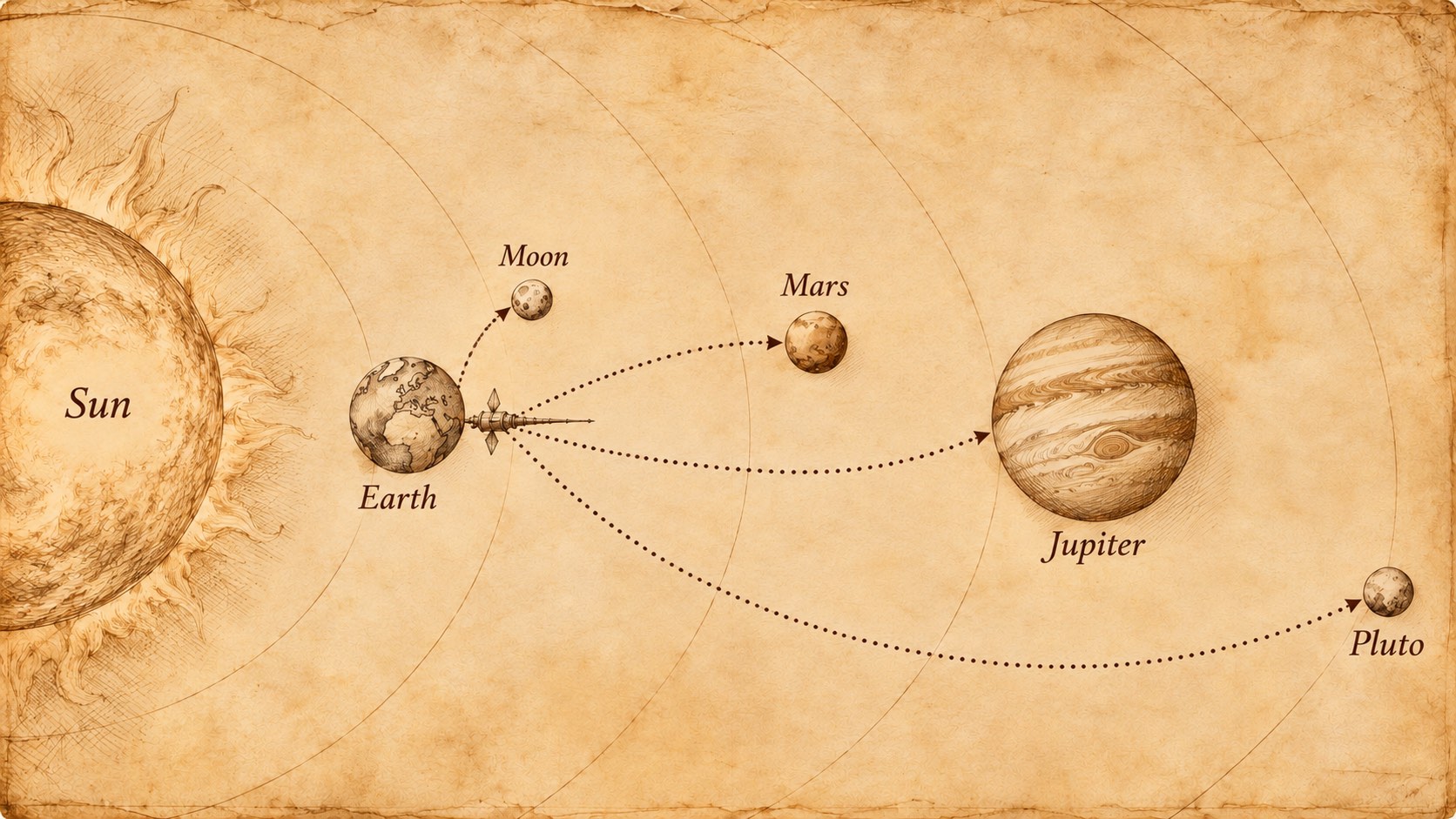
4. Now include braking: accelerate halfway, slow down halfway
A useful arrival means reaching the destination with little relative speed. In our ideal model, the solution is symmetrical:
- Accelerate at 1g through the first half of the distance. Speed rises until the midpoint.
- Reverse the thrust direction. The ship continues towards its destination, but the force now opposes its motion.
- Brake at 1g through the second half. Speed falls to zero relative to the stationary destination used in the model.
For a ship with an engine at one end, this can be pictured as a controlled turn followed by another sustained burn. Once the turn is complete, the engine can press the same cabin floor against the passengers' feet during braking. The brief transition would need its own manoeuvre; its duration is omitted from these calculations.
Braking must begin before reaching the destination. We cannot take the first table, wait until arrival, and then add a stopping interval at the same location: the ship would travel far beyond it while slowing down.
| Destination | Accelerating — first half | Braking — second half | Total time measured on Earth | Maximum speed, at the midpoint |
|---|---|---|---|---|
| Moon | About 1 h 44 min | About 1 h 44 min | 3 h 29 min | 61.4 km/s |
| Mars | 1.17 days | 1.17 days | 2.34 days | 990 km/s |
| Jupiter | 3.20 days | 3.20 days | 6.40 days | 2,712 km/s |
| Pluto | 9.05 days | 9.05 days | 18.11 days | 7,669 km/s |
| Proxima Centauri | 2.94 years | 2.94 years | 5.88 years | About 95.0% of light speed |
Values are rounded independently. These are ideal journeys through space, starting from rest between stationary endpoints. Launch, landing, gravity, orbital motion and matching a real destination's velocity would belong to a mission calculation. For the Solar System rows, the difference between onboard time and time measured on Earth is small at the precision shown.
The Moon now takes about an hour longer than the flyby. The Mars example takes roughly 16 hours longer. Braking changes the trip, but it leaves the central possibility intact: sustained 1g would make even the outer Solar System feel much closer in travel time.
Mars shows why the chosen distance matters. NASA gives an Earth–Mars separation ranging from about 54.6 million to 400.2 million km. Applying the same ideal accelerate-and-brake model to those endpoints gives approximately 1.73 to 4.68 days. A real route would also account for where Mars moves during the flight and whether the Sun obstructs a direct path. NASA: Mars Relay Network.
5. Proxima Centauri: two clocks, one journey
The interstellar row is where everyday intuition needs relativity. A steadily accelerating ship can keep providing 1g as measured inside its cabin, but its speed relative to Earth does not keep increasing by the same amount every Earth second. It approaches light speed without reaching it.
For our 4.25-light-year trip with a midpoint reversal, the calculation gives:
| Stage | Time elapsed on Earth | Time experienced aboard |
|---|---|---|
| Acceleration to the midpoint | 2.94 years | 1.77 years |
| Braking from midpoint to destination | 2.94 years | 1.77 years |
| Complete one-way journey | 5.88 years | 3.54 years |
Both durations are real. A clock on the spacecraft would record 3.54 years, while clocks synchronised with those on Earth would measure 5.88 years until arrival. The difference of 2.33 years accumulates during the journey as the spacecraft’s speed changes.
These figures come from constant proper acceleration: the acceleration measured by the ship's own instruments and felt by its passengers. We calculated both clocks from the relativistic equations, rather than applying one fixed time-dilation factor to the whole flight. University of California, Riverside: relativistic rocket equations.
Passengers would live through about three and a half ordinary years of meals, sleep, conversation and birthdays. Their clocks and bodies would not feel slowed down. Meanwhile, approximately five years and ten months would pass on Earth.
Travelling 4.25 light-years in 3.54 onboard years does not mean exceeding light speed. The 4.25-light-year separation is measured from Earth, while the 3.54-year duration is measured by the travellers. Earth-based measurements give 4.25 years for light to complete the journey and 5.88 years for the spacecraft. Its maximum speed is approximately 284,717 km/s, below light's 299,792 km/s.
The effect also changes a return journey. With the same acceleration profile in both directions and no stay at the destination, the ideal round trip would take approximately 7.09 years aboard and 11.75 years on Earth. The travellers would come home to a world that had experienced more time than they had. William H. Kinney, University at Buffalo: accelerated journeys and proper time.
6. A fast ship would still send slow news
Even this spacecraft would not make an interstellar conversation immediate. Radio signals travel at light speed, so a message sent from the destination would still take approximately 4.25 years to reach Earth in our fixed-distance model.
If the ship sent “We have arrived” at the end of the 5.88-year outward journey, Earth would receive it about 10.13 years after departure. The 5.88 years describe the flight duration calculated using clocks synchronised with those on Earth. News of the arrival takes longer to reach us because the message must also cross the distance between the stars.
This is a different kind of distance. Propulsion can shorten a ship's journey; it cannot make the subsequent radio message outrun light.
7. Could we accelerate harder while passengers sleep?
A future ship could have two operating modes: 1g during everyday activities and stronger acceleration during rest periods. Passengers would settle into specially designed beds supporting their whole bodies before thrust increased gradually. One research scenario could use 16 hours at 1g and eight hours at 2g, timed by the ship's clock. This is a design scenario; it has not been validated for repeated sleeping exposures throughout an interstellar journey.
Body position would matter. Lying with the back towards the direction of the apparent load can spread support over a larger area than standing. NASA considers acceleration direction and exposure duration separately; its technical brief records tolerance of +2g for at least 24 hours under experimental conditions along the chest-to-back axis. That finding does not establish sleeping comfort or the safety of repeating the exposure for years. NASA: Occupant Protection, p. 9.
The bed would have a specific job: distribute the force and support the body. Cushioning can reduce shocks and vibration, but it cannot cancel sustained acceleration. At 2g, even a sleeping passenger would press into the support with twice their usual weight. Breathing, circulation, local pressure, sleep quality and the ability to wake and respond would all need investigation.
How much time could stronger acceleration save? To isolate its effect, we can compare two ideal journeys that both include braking:
| Profile throughout the journey | Time elapsed on Earth | Time experienced aboard |
|---|---|---|
| Accelerate at 1g and brake at 1g | 5.88 years | 3.54 years |
| Accelerate at 2g and brake at 2g | 5.13 years | 2.29 years |
The second row calculates continuous 2g, not the schedule with eight higher-acceleration hours each day. An alternating schedule needs a phase-by-phase calculation, including braking. The comparison shows the potential: stronger acceleration can shorten the journey, especially the time experienced aboard, while the ship remains below light speed. Scheduling these intervals during sleep would aim to preserve freedom of movement at 1g during the rest of the day.
8. What would the new propulsion system need to do?
The enabling invention is a system that can sustain the required thrust for the entire accelerating and braking journey. For every tonne of instantaneous spacecraft mass, 1g requires approximately 9.8 kilonewtons of thrust in the ship's instantaneous rest frame. A brief powerful burst and years of gentle thrust are both useful capabilities, but neither alone provides the flight described here.
Fuel is one part of this challenge. A conventional rocket expels propellant, carrying much of it before it is used; the rocket equation explains why demanding more velocity change can increase the required starting mass dramatically. A different propulsion architecture could change that design problem. The travel-time calculation itself does not prescribe a particular fuel or engine. NASA: the ideal rocket equation.
Existing missions already demonstrate long-duration thrust: Dawn's ion engines, for example, provided up to 91 millinewtons each. That is a very different operating regime from a crewed ship sustaining 1g. NASA: Dawn's ion propulsion.
A future vessel would also need suitable shielding, heat management and life support. But the physical picture remains remarkable: a familiar weight underfoot, sustained long enough, could carry people to another star within a few years of their own lives—without breaking the light barrier.
How the journey times were calculated
The model uses g = 9.80665 m/s², c = 299,792,458 m/s and a year of 365.25 days. D is the starting distance in the frame where both endpoints are stationary. For the 2g comparison, replace g in the formulas with 2g. All tabulated times were calculated relativistically; ordinary constant-acceleration formulas give almost identical rounded results for the Solar System examples.
For acceleration all the way, the time measured on Earth is t = √[(D/c)² + 2D/g]. The onboard time is τ = (c/g) acosh(1 + gD/c²).
For acceleration over half the distance followed by equal braking, the total time measured on Earth is t = 2√[(D/2c)² + D/g]. The total onboard time is τ = (2c/g) acosh(1 + gD/(2c²)). Here acosh is the inverse hyperbolic cosine. At the midpoint, γ = 1 + gD/(2c²) and v = c√(1 − 1/γ²).
At low speeds, the simpler expressions are t = √(2D/g) for the flyby and t = 2√(D/g) when stopping. This explains why adding braking increases the low-speed trip time by a factor of √2, rather than doubling it: each acceleration phase now covers only half the distance.
The calculation treats the spacecraft as a point following a straight route in flat spacetime, with an instantaneous change of acceleration at the midpoint. It excludes propulsion limits, launch and landing, gravity, moving destinations, manoeuvre duration and any stopover. Numerical integration of the onboard clock was checked independently against the formulas. Sources were reviewed on 17 November 2026.