
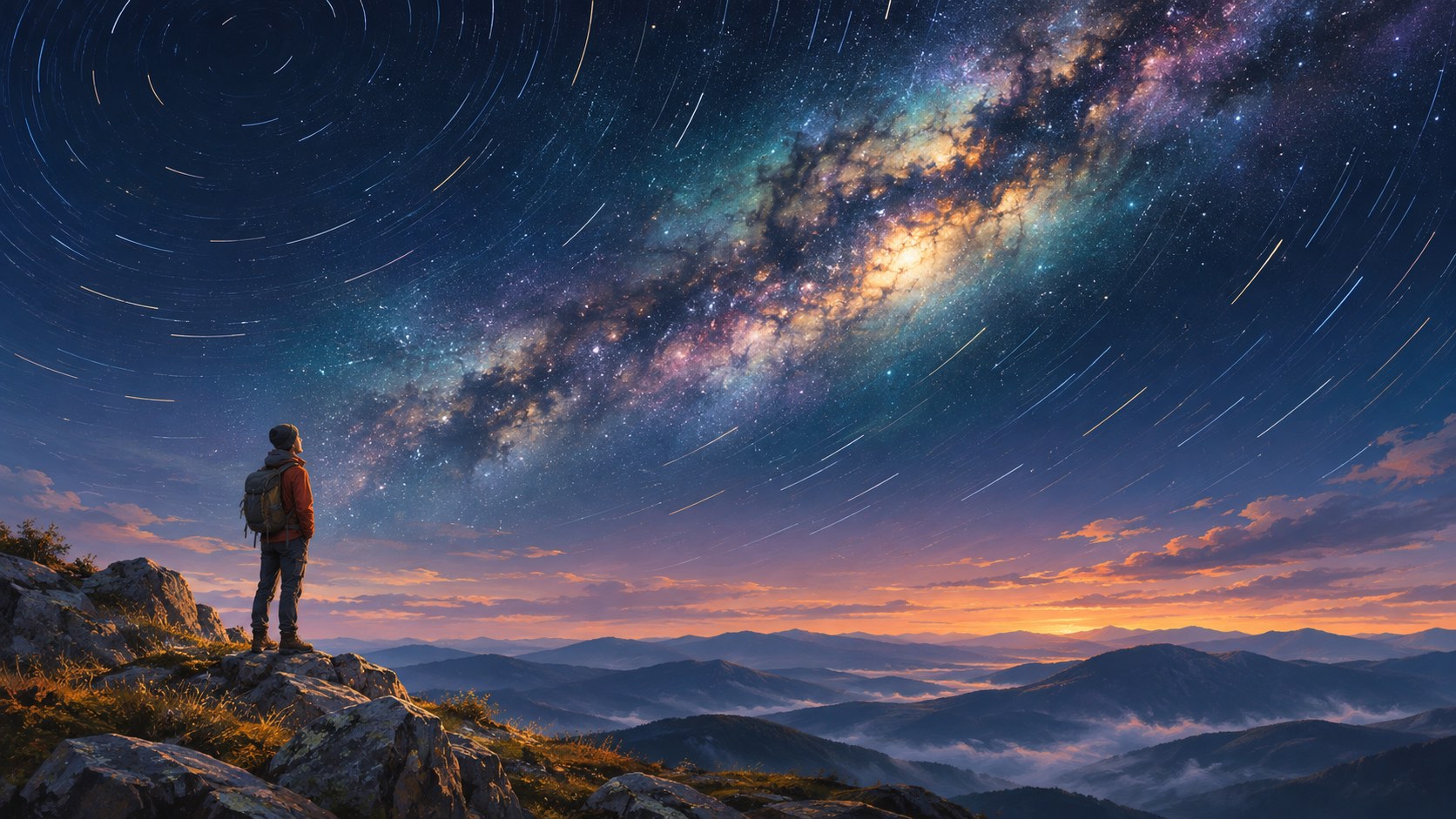
The room is quiet. Your cup rests on the table. Nothing seems to move. Yet, while you read this sentence, Earth is carrying you almost 30 kilometres around the Sun every second. The Sun itself is travelling around our galaxy, and the galaxy belongs to a group sweeping through the cosmos at roughly 2.3 million kilometres an hour.
We spend our lives inside this extraordinary journey. We sleep through it, work through it and watch the evening sky without feeling the enormous distances passing beneath our everyday sense of stillness. A chair can hold us in one place in a room; it cannot take us out of the movement of the planet, the Solar System and the wider Universe.
The journey becomes easier to picture if we follow it outwards, from the ground beneath our feet to the galaxies beyond our own.
1. The ground beneath you is turning
Earth rotates around its axis, carrying its surface from day into night and back again. At the equator, the ground moves at approximately 1,674 km/h because of this rotation alone. A person standing there travels almost 465 metres each second around Earth's axis, without taking a step.
Farther from the equator, the circle around the axis becomes smaller. Everyone completes essentially the same daily turn, but someone at a higher latitude covers less distance during it. At 45° north or south, the rotational speed is about 1,184 km/h.
| Latitude | Approximate rotational speed | Distance in one second |
|---|---|---|
| Equator — 0° | 1,674 km/h | 465 metres |
| 30° north or south | 1,450 km/h | 403 metres |
| 45° north or south | 1,184 km/h | 329 metres |
| 60° north or south | 837 km/h | 233 metres |
| Geographic pole — 90° | 0 km/h around the axis | The pole remains on the rotation axis. |
These values use a simple spherical model: rotational speed is approximately 1,674 × cos(latitude) km/h. The equatorial value comes from Earth's radius and rotation period in the NASA Earth Fact Sheet. The table is rounded; altitude and Earth's slightly flattened shape would matter for a precise calculation.
Standing exactly at a geographic pole removes this circular journey around the axis. It does not remove the much larger journey around the Sun.
Our planet turns a little faster than the clock suggests. One rotation relative to distant stars takes about 23 hours and 56 minutes. The familiar 24-hour day follows the Sun: as Earth moves along its orbit, it has to turn slightly farther for the Sun to return to the same meridian. NASA: reference systems.
2. Earth carries you around the Sun at 107,000 km/h
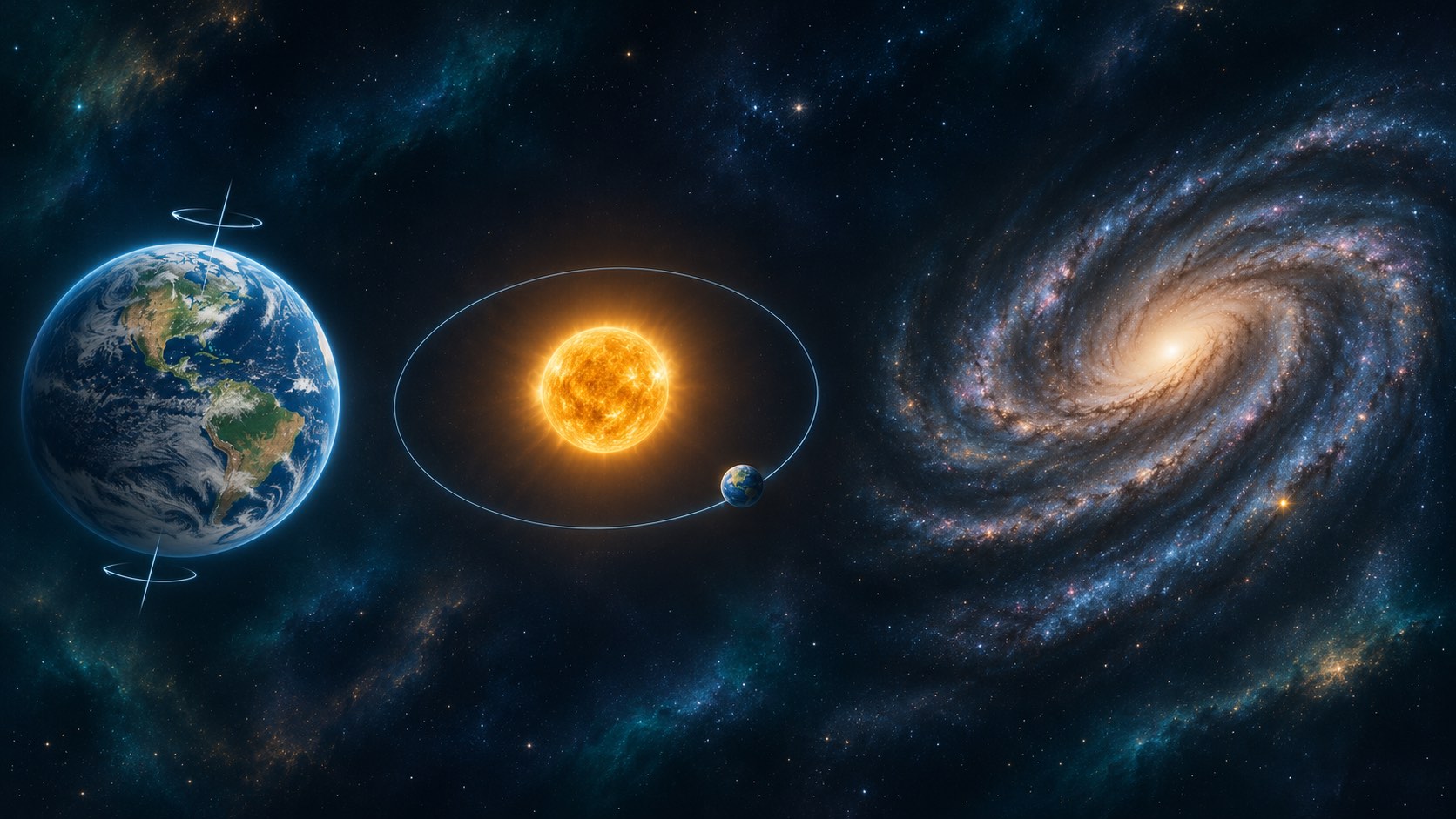
Beyond the daily rotation lies the yearly voyage. Earth's mean orbital speed is approximately 29.8 km/s, or 107,000 km/h. Its slightly elliptical orbit makes the speed vary during the year, from about 29.3 to 30.3 km/s. NASA: Earth orbital parameters.
At the mean speed, a five-minute pause for coffee takes place during a journey of roughly 8,940 kilometres along Earth's orbit. Over an eight-hour sleep, the planet travels around 858,000 kilometres along that path. Your home, the neighbouring streets and the oceans make the same journey.
It is an unusual way to think about an ordinary morning: before you have walked to the door, you have already spent hours travelling through the Solar System. The distance on a fitness tracker measures movement across the ground. It does not record the journey of the ground itself.
A jump does not leave you behind because you already share Earth's motion before your feet leave the floor. The same principle is familiar in a smoothly moving train: a small toss of a ball does not cancel its forward motion and send it racing towards the rear of the carriage.
3. The Sun is taking the whole Solar System through the galaxy
The Sun is a moving star. Along with its planets, it orbits the centre of the Milky Way at about 230 km/s, equivalent to 828,000 km/h. Our home in the galaxy is the Orion Spur, away from the bright central region. NASA: Solar System facts.
At that speed, the Solar System travels about 69,000 kilometres in five minutes along its galactic path. During an eight-hour sleep, that becomes approximately 6.6 million kilometres. Earth continues its own orbit around the Sun throughout this much larger journey.
The scale is difficult to absorb. Even at hundreds of thousands of kilometres an hour, a complete circuit of the Milky Way takes approximately 230 million years. This vast interval is sometimes called a galactic year. Human calendars divide a small part of a journey that began long before people existed. NASA: our galactic orbit.
The Solar System is held together by gravity while it moves. The planets do not need to stop circling the Sun to travel with it, just as the Moon can circle Earth while both continue around the Sun.
4. Our galaxy group travels at about 2.3 million km/h
The Milky Way belongs to the Local Group, a family of galaxies that includes Andromeda and smaller neighbours. The group itself has a large-scale motion through the Universe.
One established estimate puts that motion at 627 ± 22 km/s relative to the cosmic microwave background. Rounded for everyday reading, that is about 630 km/s, or 2.3 million km/h. In a single minute, the group's motion amounts to roughly 38,000 kilometres. Lavaux and colleagues: cosmic flow from the 2MASS Redshift Survey.
This is the largest scale of our journey in this article: a moving planet, around a moving star, in a galaxy that belongs to a moving group. None of it waits for us to notice.
The cosmic microwave background, usually abbreviated to CMB, is radiation left from the early Universe, visible to instruments in every direction. It provides astronomers with a broad reference against which to measure motion. Movement makes this radiation appear slightly warmer in one direction and cooler in the opposite direction. NASA LAMBDA: the CMB dipole.
The 2.3 million km/h figure describes the Local Group's motion as a whole. Within that travelling group, galaxies and stars also have their own motions. For the Solar System's centre of mass, Planck reports about 370 km/s, or 1.33 million km/h, relative to the same background. This is the more relevant figure when describing our Solar System's journey through the CMB; our location on Earth adds smaller daily and yearly variations. Planck Collaboration: overview and cosmological legacy.
What happens during five quiet minutes?
A short break is enough for enormous astronomical distances to pass. These examples use the rounded speeds discussed above and describe the path travelled at each scale.
| The traveller | Its journey during five minutes | Approximate distance |
|---|---|---|
| Earth | Along its orbit around the Sun | 8,940 km |
| The Solar System | Along its orbit around the Milky Way's centre | 69,000 km |
| The Local Group | Through the CMB reference frame | 189,000 km |
The distances belong to different views of the same larger journey. The ground, Sun and cosmic background each give us a way to describe where we are going. An exact personal speed in one chosen reference would also depend on the directions of motion and the moment of measurement.
Voyager: leaving the Solar System, still travelling with the galaxy
Two small spacecraft make this journey tangible. Launched in 1977, Voyager 1 and Voyager 2 have travelled beyond the planets and into interstellar space. Their paths now lead above and below the plane in which Earth and most planets orbit the Sun. NASA: Voyager trajectories.
Where are they now?
| Measurement | Voyager 1 | Voyager 2 |
|---|---|---|
| Distance from Earth | 25.9 billion km | 21.7 billion km |
| Distance from the Sun | 25.8 billion km — 172.3 AU | 21.6 billion km — 144.5 AU |
| Speed relative to the Sun | 60,900 km/h — 16.9 km/s | 54,900 km/h — 15.3 km/s |
| Radio signal travel time to Earth | Almost 24 hours | About 20 hours 5 minutes |
An astronomical unit (AU) is approximately the Earth–Sun distance: 150 million kilometres. The figures above are a dated snapshot; NASA's mission tracker shows the changing distances and estimated speeds.
Voyager 1 is approaching a striking milestone. NASA predicts it will reach one light-day from Earth on 18 November 2026. A message travelling at light speed will then take a full day to reach it, and an immediate reply another full day to return. NASA: the one-light-day milestone.
Have they already left the Solar System?
They have crossed one important boundary, with a much more distant region still ahead:
- The heliopause: the boundary between the Sun's outward-flowing solar wind and the surrounding interstellar medium. Voyager 1 crossed it on 25 August 2012; Voyager 2 on 5 November 2018. Both are already exploring interstellar space. NASA: Voyager 1; JPL: Voyager 2's crossing.
- The Oort Cloud: a vast, distant population of icy bodies orbiting the Sun. Its outer extent is used as a broader edge of the Solar System. NASA estimates a journey of a few centuries for the Voyagers to reach its inner region, and possibly around 30,000 years to pass beyond it. These are approximate timescales: the cloud's extent is uncertain. NASA: the scale of the Oort Cloud.
Is it like jumping out of a moving train?
Imagine a ball released sideways from a train travelling at 100 km/h. At that instant, the ball still has roughly the train's forward speed relative to the ground. Air resistance and contact with the ground subsequently change its motion. Passing through the doorway does not cancel its speed. This is inertia, described by Newton's first law.
The same principle explains Voyager's journey. The probes already shared the Solar System's movement through the galaxy when they launched. Crossing the heliopause changes the particles and magnetic environment around them; it does not suddenly remove that inherited motion. The Sun's gravity weakens gradually with distance, without switching off at a boundary.
Voyager is separating from the Sun at roughly 15–17 km/s, while both spacecraft and Sun continue through the galaxy. The 69,000 km in five minutes calculated earlier describes the Solar System's galactic journey, not a gap that suddenly opens between it and the probes. Their escape trajectories carry them farther from home, but leaving the Solar System does not mean leaving the Milky Way.
Long after their last radio signals, the spacecraft will continue travelling. Losing electrical power ends their ability to communicate; it does not bring their journey to a halt.
How does that compare with the speed of light?
The Local Group's roughly 2.3 million km/h corresponds to about 0.21% of the speed of light — approximately 0.0021 times light speed. Light is still about 480 times faster than the group's estimated motion.
The comparison puts two extraordinary scales beside each other. A speed that is immense by everyday standards is only around two-thousandths of the speed of light. In vacuum, light travels at exactly 299,792,458 metres per second, or approximately 1.079 billion kilometres an hour. BIPM: the metre and the speed of light.
For comparison, the Solar System's approximately 370 km/s relative to the CMB is about 0.12% of light speed. The difference comes from measuring the motion of different objects within the same travelling cosmic neighbourhood.
Why does such a fast journey feel so still?
Our bodies respond to pushes, braking, turning and vibration. They do not directly sense uniform motion in a straight line. In a smoothly travelling vehicle, the surroundings inside can feel almost still; on Earth, the ground, atmosphere and everyday objects already share the planet's large-scale motion. NASA: motion and reference frames.
Earth's rotation does change our direction continuously, so it involves acceleration. At the equator, this is about 0.034 m/s², roughly 0.35% of ordinary gravitational acceleration. Its effect is small and steady. During the orbit around the Sun, Earth and its surroundings are falling together along their curved path. NASA's physics explanation.
The calm we feel is real at the scale of the room. So is the movement beyond it. A sleeping person, a quiet library and a mountain at sunset are all part of this immense, uninterrupted journey.
The next time you pause and feel that nothing is happening, imagine the Earth continuing around the Sun, the Sun carrying its planets through the Milky Way, and our galaxy group moving through the ancient background light. Stillness is a local experience. The journey continues.
Sources and calculations
Researched on 13 November 2026. NASA and the linked research papers provide the astronomical values; BIPM provides the exact speed of light. Speeds are rounded for readability. The Local Group value is an established literature estimate, rather than a live measurement.
Distances are illustrative calculations using speed multiplied by time: 300 seconds for five minutes and 28,800 seconds for eight hours. Light-speed percentages use 299,792.458 km/s. The latitude table uses a spherical approximation.